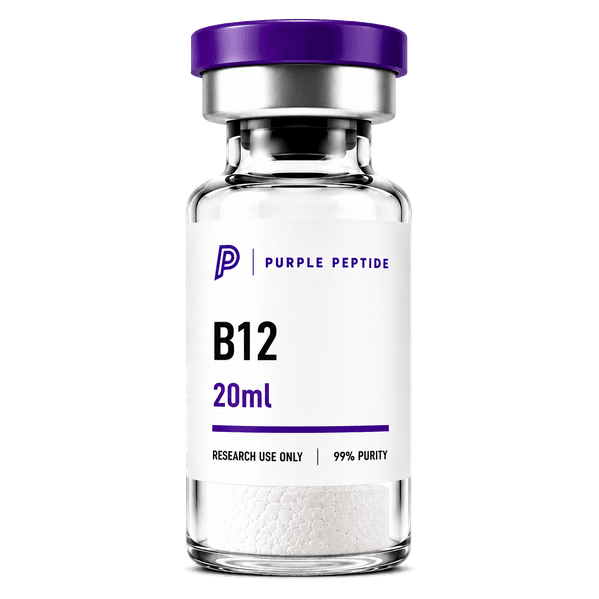
B-12
Methylcobalamin — the coenzyme form of vitamin B12 studied in one-carbon and methylation metabolism
Sign up for verified researcher access to view pricing, see in-stock quantity, and order at member volume tiers (up to 20% off at 20+ vials).
Specifications
| Molecular weight | 1344.38 g/mol (methylcobalamin) |
| Molecular formula | C63H91CoN13O14P |
| Compound class | Cobalamin (vitamin B12) coenzyme — not a peptide |
| Appearance | Dark red lyophilized powder or solution |
| Solubility | Water; bacteriostatic water for injection |
| Storage (lyophilized) | -20°C, protected from light |
| Half-life | Enters the cellular cobalamin salvage and methionine-synthase pathways |
B-12 is methylcobalamin, one of the two coenzyme forms of vitamin B12 — a cobalt-containing corrinoid cofactor, not a peptide. Methylcobalamin serves as the cofactor for methionine synthase, the enzyme that regenerates methionine from homocysteine and links folate and one-carbon metabolism to cellular methylation. Its molecular formula is C63H91CoN13O14P, with a molecular weight of approximately 1344.38 g/mol. Purple Peptide supplies B-12 as a lyophilized methylcobalamin powder for laboratory research use only, third-party tested for identity and purity.
Biochemistry and research context
Vitamin B12 (cobalamin) exists in several forms distinguished by the group bound to the central cobalt atom. Methylcobalamin carries a methyl group and is the form directly used by methionine synthase; adenosylcobalamin is the mitochondrial form used by methylmalonyl-CoA mutase. In laboratory research, methylcobalamin is studied as a cofactor in one-carbon metabolism — the folate-coupled network that supplies methyl groups for nucleotide synthesis and for methylation of DNA, proteins, and lipids — and in the remethylation of homocysteine to methionine.
For authoritative background on cobalamin biochemistry and forms, see the U.S. National Institutes of Health Office of Dietary Supplements professional fact sheet on vitamin B12 (ods.od.nih.gov). Purple Peptide references this material for scientific background only; it does not constitute guidance for any use of this research compound.
Storage & handling
Lyophilized powder: Store at -20°C, protected from light. Cobalamins are light-sensitive — keep vials in their box or otherwise shielded from direct light. Stable for 12+ months under correct storage.
Vial format: 20 mg lyophilized methylcobalamin in a vacuum-sealed glass vial with rubber stopper and aluminum crimp.
Shipping: Lyophilized methylcobalamin is stable at ambient temperature for the typical 1–3 day shipping window. Cold-pack shipping available on request.
Frequently asked questions
Is B-12 a peptide?+
No. B-12 (methylcobalamin) is a cobalamin — a cobalt-containing corrinoid cofactor, not a peptide. It is supplied here in lyophilized form because, like the peptides in this catalog, it is most stable as a dry powder, and because it is used as a research cofactor alongside them.
What is the difference between methylcobalamin and cyanocobalamin?+
Both are forms of vitamin B12. Cyanocobalamin is a synthetic, highly stable form that carries a cyano group on the central cobalt and is converted to active coenzyme forms inside cells. Methylcobalamin already carries the methyl group used directly by methionine synthase. Purple Peptide supplies the methylcobalamin form; the active corrinoid ring system is the same in both.
What does Purple Peptide test B-12 for?+
Every batch of B-12 is tested by an independent third-party laboratory for identity and purity (HPLC), bacterial endotoxin (USP <85>), heavy metals (USP), and sterility (USP).
How should B-12 be stored?+
Lyophilized methylcobalamin is stable at -20°C, protected from light, for 12+ months. Cobalamins degrade with light exposure, so shielding vials from light matters more than for many other compounds.