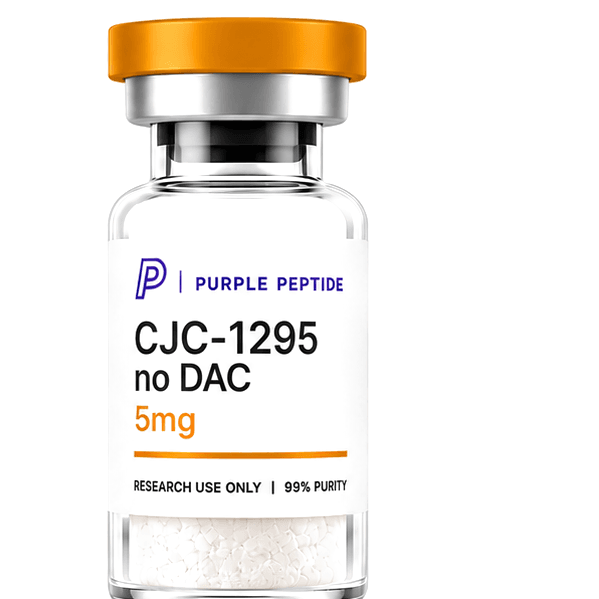
CJC-1295 no DAC research vial
Sequence length
29 AA
Molecular weight
3367.9 g/mol
GH axis · Growth factors / GHRH analog research

CJC-1295 no DAC

Tetrasubstituted GHRH(1-29) analog — also called Modified GRF 1-29

CJC-1295 no DAC (5mg vials)

Sign up for verified researcher access to view pricing, see in-stock quantity, and order at member volume tiers (up to 20% off at 20+ vials).

Sign up to view pricing and order.Verified researchers only. Active immediately on sign-up.
Apply for access →

Specifications

Molecular weight3367.9 g/mol
Sequence length29 amino acids
Amino acid sequenceTyr-D-Ala-Asp-Ala-Ile-Phe-Thr-Gln-Ser-Tyr-Arg-Lys-Val-Leu-Ala-Gln-Leu-Ser-Ala-Arg-Lys-Leu-Leu-Gln-Asp-Ile-Leu-Ser-Arg
AppearanceWhite lyophilized powder
SolubilityBacteriostatic water; sterile water
Storage (lyophilized)-20°C, protected from light
Half-life~30 minutes in plasma (in vivo, animal model)

CJC-1295 no DAC — also called Modified GRF 1-29 (Mod GRF 1-29) — is a synthetic 29-amino-acid analog of human growth hormone-releasing hormone (GHRH). It is the tetrasubstituted form of hGRF(1-29): four residues of the native sequence are replaced (D-Ala at position 2, Gln at 8, Ala at 15, Leu at 27) to confer resistance to dipeptidyl peptidase-IV (DPP-4) and other plasma proteases while retaining GHRH receptor activity. This "no DAC" variant lacks the drug-affinity-complex (maleimidopropionamide-lysine) modification of CJC-1295 with DAC, so it does not form a covalent albumin conjugate in vivo and circulates with a much shorter plasma half-life (~30 min vs. ~6–8 days). Purple Peptide supplies CJC-1295 no DAC as a lyophilized powder, third-party tested for purity and endotoxin conformance, for laboratory research use only.

Research Studies

The following studies are summarized for educational purposes only. Inclusion does not imply any human use; all referenced research was conducted in vitro or in animal models, or in historical clinical research on the parent GHRH(1-29) class.

Research study

Human growth hormone-releasing factor (hGRF)1-29-albumin bioconjugates activate the GRF receptor on the anterior pituitary in rats: identification of CJC-1295 as a long-lasting GRF analog

Jetté L, Léger R, Thibaudeau K, Benquet C, Robitaille M, Pellerin I, Paradis V, van Wyk P, Pham K, Bridon DP. Endocrinology. 2005 Jul;146(7):3052–8. View source ↗

Scientific findings

This foundational study from ConjuChem characterized the tetrasubstituted hGRF(1-29) scaffold that underlies both CJC-1295 with DAC and the "no DAC" Modified GRF 1-29 used in laboratory research. The authors synthesized three maleimido derivatives of hGRF(1-29) and bioconjugated them to human serum albumin ex vivo; all three conjugates showed enhanced in vitro stability against dipeptidyl peptidase-IV (DPP-4) relative to native hGRF(1-29), and all retained bioactivity in a growth hormone secretion assay in cultured rat anterior pituitary cells. The amino-acid substitutions at positions 2 (D-Ala), 8, 15, and 27 — the same modifications present in Mod GRF 1-29 — were responsible for the protease resistance. When administered subcutaneously to male Sprague-Dawley rats, the lead compound (CJC-1295) produced a four-fold increase in GH area-under-the-curve over two hours compared with hGRF(1-29). Western blot analysis of plasma from injected rats showed a CJC-1295 immunoreactive species at the molecular weight of serum albumin, present beyond 24 hours, confirming the albumin-binding mechanism specific to the DAC variant.

Plain English

Researchers built modified versions of the natural GHRH peptide by swapping four amino acids in its 29-residue core. Those same four swaps are what define Modified GRF 1-29 (CJC-1295 no DAC). In the lab, the modified peptide held up much better against the enzyme DPP-4 that normally chews up GHRH within minutes, and it still activated growth hormone-releasing receptors on pituitary cells. This study is the reference point for understanding why Mod GRF 1-29 is more stable than unmodified Sermorelin while still doing the same job at the receptor.

Research study

Once daily subcutaneous growth hormone-releasing hormone therapy accelerates growth in growth hormone-deficient children during the first year of therapy. Geref International Study Group

Thorner M, Rochiccioli P, Colle M, Lanes R, Grunt J, Galazka A, Landy H, Eengrand P, Shah S. J Clin Endocrinol Metab. 1996 Mar;81(3):1189–96. View source ↗

Scientific findings

This multicenter open-label study examined unmodified GHRH(1-29)-NH2 (sermorelin / Geref) — the parent peptide that Mod GRF 1-29 is a stabilized analog of — in 110 previously untreated prepubertal GH-deficient children. Subjects received 30 µg/kg/day of GHRH(1-29) subcutaneously at bedtime for up to 12 months. Mean height velocity rose from 4.1 ± 0.9 cm/yr at baseline to 8.0 ± 1.5 cm/yr at 6 months and 7.2 ± 1.3 cm/yr at 12 months. At 6 months, 74% of subjects were classified as good responders. No adverse changes in general biochemical or hormonal panels were noted; fasting glucose was unchanged and no excessive generation of IGF-1 was observed. The data established that pulsatile GHRH(1-29) receptor activation at the pituitary is sufficient to drive sustained downstream GH/IGF-1 output without exogenous GH replacement — the same receptor mechanism engaged by Mod GRF 1-29.

Plain English

Doctors gave a once-nightly injection of the unmodified 29-amino-acid GHRH peptide (the parent of Mod GRF 1-29) to children whose pituitaries underproduced growth hormone. Over a year, the children's growth rate roughly doubled. This was a classic demonstration that gently nudging the pituitary's GHRH receptor is enough to raise the body's own growth hormone output — without injecting growth hormone itself. Mod GRF 1-29 is studied in animal and in vitro work because it engages the same receptor, just with better stability than the parent peptide used in this trial.

Storage & handling

Lyophilized powder: Store at -20°C, protected from light. Stable for 24+ months under correct storage. Avoid repeated temperature cycling.

Vial format: 5 mg lyophilized, vacuum-sealed glass vial with rubber stopper and aluminum crimp. Sterility tested per USP guidelines.

Shipping: Lyophilized CJC-1295 no DAC is stable at ambient temperature for the typical 1–3 day shipping window. Cold-pack shipping available on request.

Frequently asked questions

What is CJC-1295 no DAC, and is it the same as Modified GRF 1-29?+

Yes — CJC-1295 no DAC and Modified GRF 1-29 (Mod GRF 1-29) are the same molecule. It is a 29-amino-acid synthetic analog of human GHRH(1-29) with four substitutions: D-Ala at position 2 (blocks DPP-4 cleavage), Gln at 8, Ala at 15, and Leu at 27. Molecular weight is approximately 3367.9 g/mol. The sequence is Tyr-D-Ala-Asp-Ala-Ile-Phe-Thr-Gln-Ser-Tyr-Arg-Lys-Val-Leu-Ala-Gln-Leu-Ser-Ala-Arg-Lys-Leu-Leu-Gln-Asp-Ile-Leu-Ser-Arg.

What is the difference between CJC-1295 no DAC and CJC-1295 with DAC?+

Both share the same tetrasubstituted GHRH(1-29) backbone. The "with DAC" version (CJC-1295 DAC) carries an additional N-epsilon-3-maleimidopropionamide group on a C-terminal lysine; that maleimide forms a covalent bond with cysteine-34 of serum albumin in vivo, producing a half-life of roughly 6–8 days. The "no DAC" version lacks this albumin-binding linker, so its plasma half-life in animal studies is on the order of 30 minutes — useful for research protocols modeling pulsatile GHRH receptor activation. Molecular weight differs accordingly (~3367.9 g/mol for no DAC vs. ~3647 g/mol for DAC).

How is CJC-1295 no DAC different from Sermorelin?+

Sermorelin is unmodified GHRH(1-29)-NH2 — the first 29 residues of natural human GHRH, with no amino-acid substitutions. CJC-1295 no DAC / Mod GRF 1-29 is the tetrasubstituted version of that same sequence. The four substitutions (positions 2, 8, 15, 27) confer resistance to dipeptidyl peptidase-IV and other plasma proteases, extending the in-plasma half-life from ~10–20 minutes (Sermorelin) to ~30 minutes (Mod GRF 1-29) in animal models, while engaging the same GHRH receptor at the anterior pituitary.

What does Purple Peptide test CJC-1295 no DAC for?+

Every batch of CJC-1295 no DAC supplied by Purple Peptide is tested by an independent third-party laboratory for: identity and purity (HPLC + MS), bacterial endotoxin (USP <85>), heavy metals (USP), and sterility (USP).

What is the purity of your current CJC-1295 no DAC batch?+

Recent batches have tested above 99% pure by HPLC.